 MTR
 MTR · Care×

SEN Phase 2 proposal · November 2026
Every journey,
safely home.
Using MTR’s in-station positioning network and Collectiv’s Deep World Model to give SEN families confidence on every trip.
Draft for discussion · Concept screens and simulations are illustrative
The proposal on one page
Help every SEN child travel safely, and want to travel.
1The problem
- 46% of autistic children aged 4–7 have wandered off or bolted
- 35% can almost never give their name or phone number
- 41.5 min average time missing
- 71,000+ SEN students in Hong Kong mainstream schools
- Families are already asking MTR for the next step
2What we propose
3Why MTR, why now
- Built on what’s there. Positioning network, MTR Care app and staff devices are in place. A coverage check shows where a few extra points help
- Admiralty is already modelled in the Deep World Model
- MTR Care already wins awards: UITP 2025, Triple Gold, HK ICT 2024
- Proven worldwide: 23 cases, 8 in Asia
- One partner: Collectiv becomes MTR Care’s primary vendor after Phase 1
4What we ask
- A working session with the MTR Care team first; Heep Hong, Caritas and others can join later
- Choose a pilot option. We recommend Option B
- Agree measures, privacy approach and operations
- Agree commercial terms
01 · The need
Wandering is common. Minutes matter.
Average time missing, among children who went missing.
At an ordinary walking pace, that is enough time to cover ~2.5 km — or to board several trains. Every minute without a known location makes the search area larger (see the search-area model →)
Sources: Anderson et al., Pediatrics 2012; Kiely et al., PLOS ONE 2016; IAN survey. Distance assumes ~1 m/s walking pace.
02 · Hong Kong
The need here is large — and growing.
SEN students in mainstream public primary and secondary schools this year
estimated autism prevalence among children aged 6–17 (2025 study)
elderly people with dementia reported missing to police in one year
non-Chinese residents — 8.4% of the population, many with limited Chinese
SEN is the starting point.
The same platform serves far more passengers.
Sources: EDB via TVB News 2026; SCMP 2025; HK Police via HK01 (Dec 2021–Nov 2022); 2021 Population Census
03 · Where we start
MTR has already made SEN travel a priority.
Phase 2 builds on all of this. It doesn’t replace it — it connects it.
stations + Light Rail
「感囊」 sensory bags available from staff, with Heep Hong Society
children and parents
Summer station visits with Heep Hong and Caritas
stations on tour
「SEN途有里」 exhibition with Caritas, using first-person sensory video
MTR Care Phase 1
Flip & Match, a calming drawing game, and a 5-step Daily Check-in in the app
Connected, always-on
From items and awareness to a service that finds families when they need it.
Today: items & awareness
- Family must find staff to get a sensory bag
- Help depends on someone noticing
- Planning ahead relies on memory and visits
Phase 2: a connected service
- Help comes to the family, at their exact location
- Staff are in the loop before anyone panics
- Skills practised at home are used on the real trip
Sources: Sing Tao Headline, 21–23 Oct 2026; MTR Care team
04 · What families said next
Families are already asking for the next step.
Within days of the 「感囊」 rollout, two concrete ideas surfaced online. Hover each one to see the Phase 2 answer.
An SEN-friendly carriage
Borrow Japan’s women-only car idea: a carriage with ear defenders and a calm-down space.
Register online, not at the counter
Book the sensory bag online with proof of eligibility, so it reaches the families who need it.
The unspoken worry
“What if my child runs off and can’t tell anyone who they are?”
Source: Sing Tao Headline, 26 Oct 2026 (online reaction to the 「感囊」 rollout)
05 · What’s already in place
The infrastructure is already in every station.
Phase 2 is a software layer on top of assets MTR has already deployed. Click a feature to see exactly what it depends on.
Positioning network
In all 99 stations, already powering MTR Care’s in-station navigation.
Deep World Model
A 3D model of each station that understands what every space is: gates, platforms, lifts, exits, crowds. Admiralty is complete; each further station takes days, up to a few weeks for the largest interchanges.
MTR Care app
Already serves customers with special needs, incl. non-emergency help requests.
Staff devices
Station staff already carry smartphones and tablets.
Octopus integration
Needed for Tier 1 gate alerts only — integration work, no new station hardware.
Across all Phase 2 features. The only external dependency is Octopus — and only for Tier 1.
Deep World Model · built already
This is Admiralty. Already in the Deep World Model.
Not a drawing: all six levels captured with Collectiv’s Deep World Model scanning and aligned to the Lands Department 3D indoor map, with a crowd simulation running on the real walkable floor. Every feature in this proposal runs on this model. Try it.
Model: Collectiv’s Deep World Model of Admiralty, from DWM scanning; level heights and connections from the Lands Department 3D Indoor Map (map from Lands Department). Crowd is a simulation for illustration, not live passenger data.
06 · How it lives in MTR Care
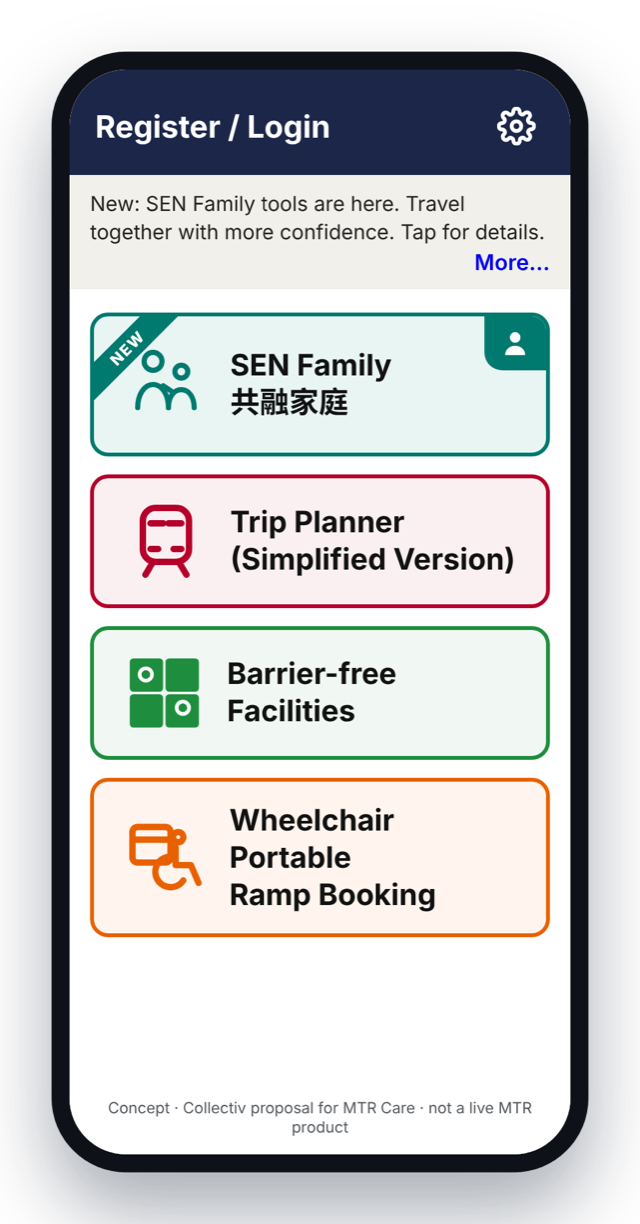
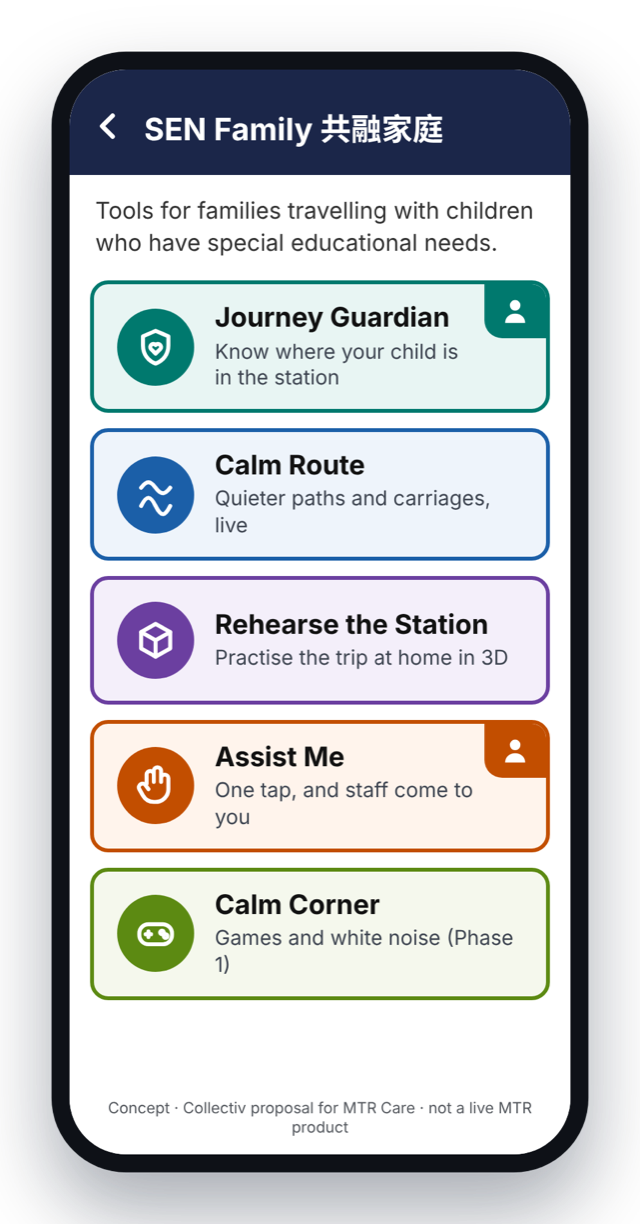
One new tile. Everything a family needs behind it.
- No clutter. The home screen gains one tile, not six.
- Feels familiar. Same navy header, colour tiles, BETA ribbon and login tab users already know.
- Phase 1 has a home. Its games and Daily Check-in sit in the hub’s Calm Corner. Phase 2 builds on them, not around them.
07 · The big idea
From practising at home to travelling alone, one rung at a time.
Phase 1 teaches travel skills at home. Phase 2 is with the child on the real journey. Every idea has a place on the way to independence, parents decide when to move up, and the safety net never goes away.
Independent travel training for young people with SEN is run by many UK councils and moves step by step from accompanied to solo trips. Rungs and criteria are a proposal to agree with the MTR Care team and therapists.
Idea 1 · The hero
Journey Guardian 同行守護
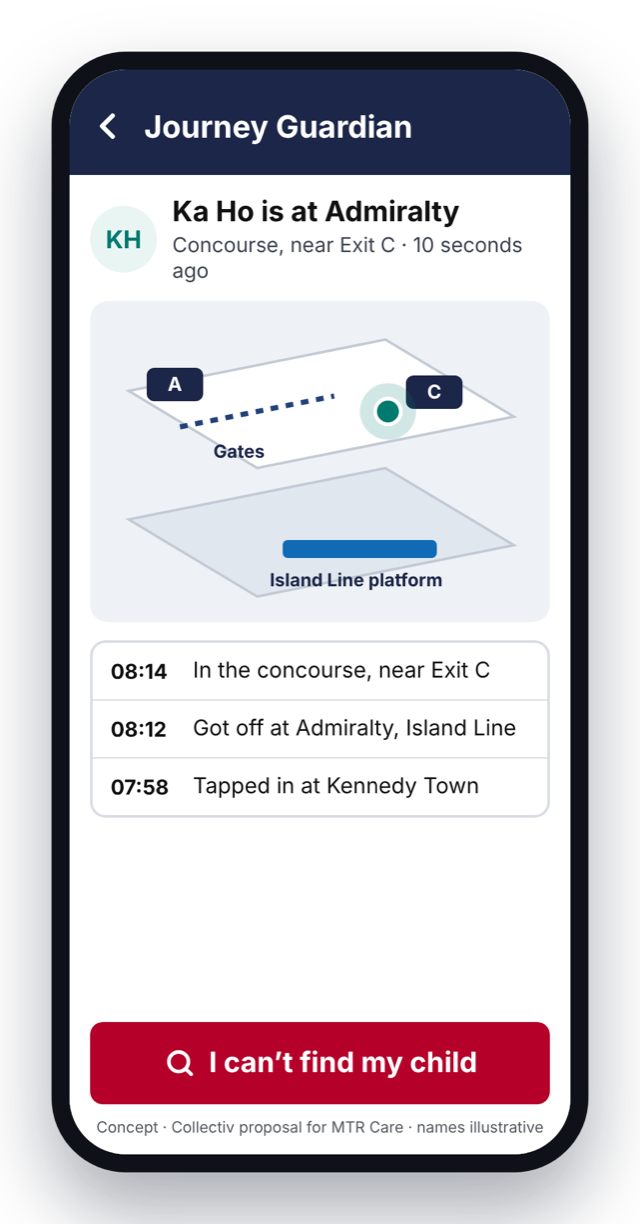
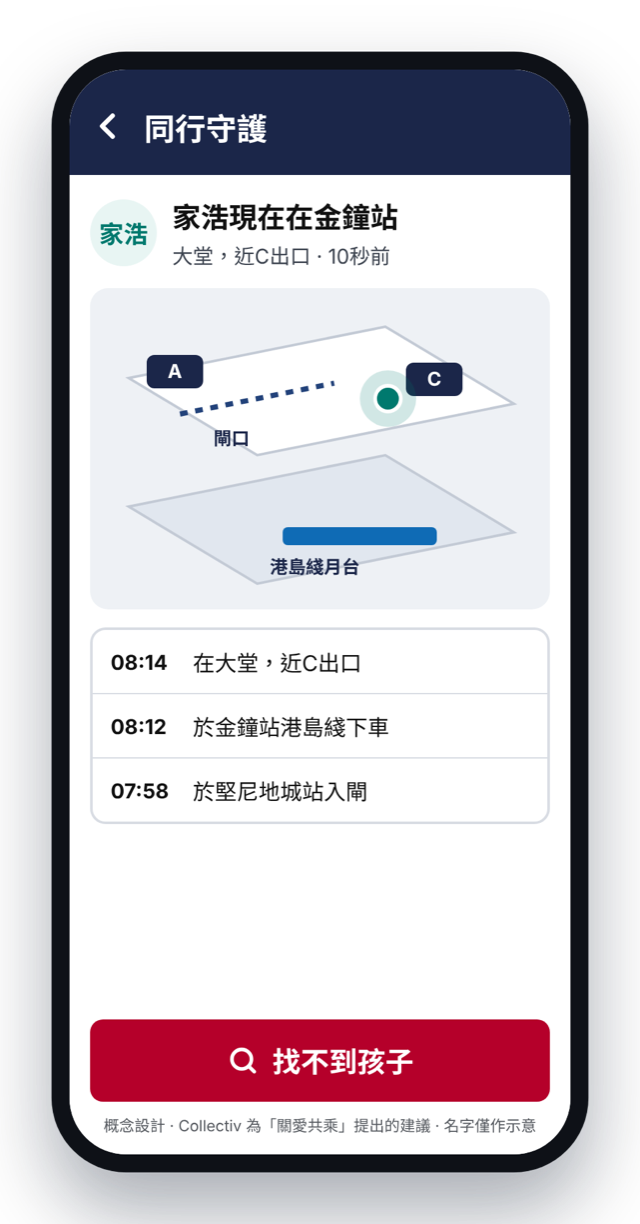
Parents see where their child is, from the ticket gate to the platform — and MTR staff are in the loop. Press play to follow Ka Ho’s trip to school, inside the real Admiralty model. Then switch tiers off to see what each one adds.
Tier 3 in action
When a child goes missing, minutes count.
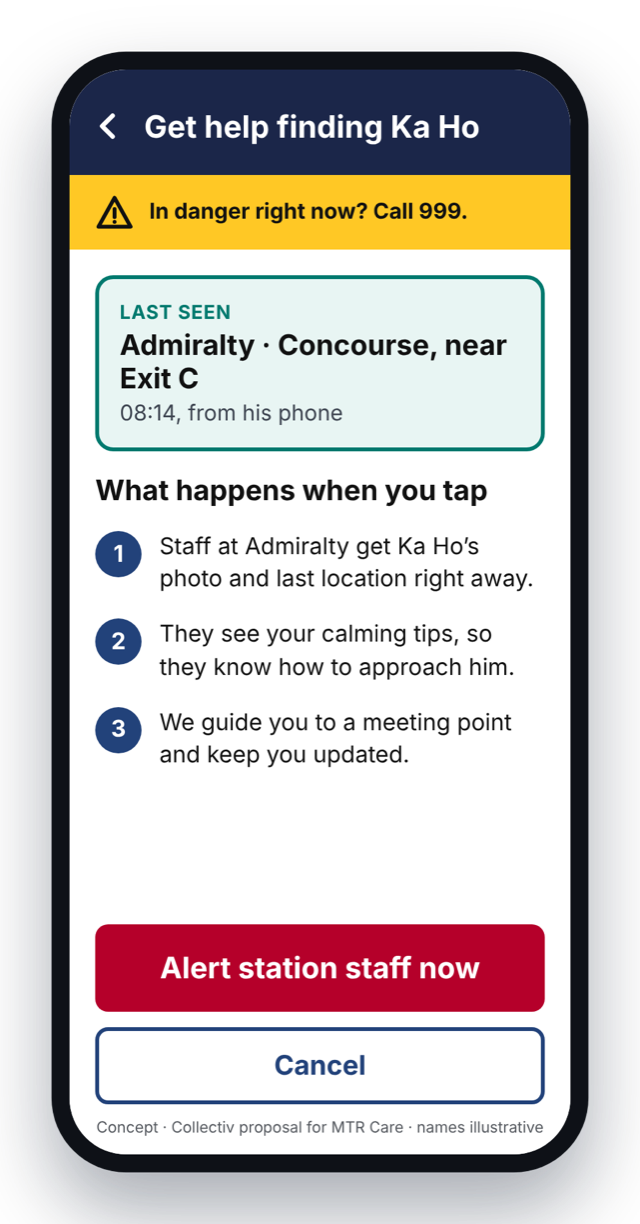
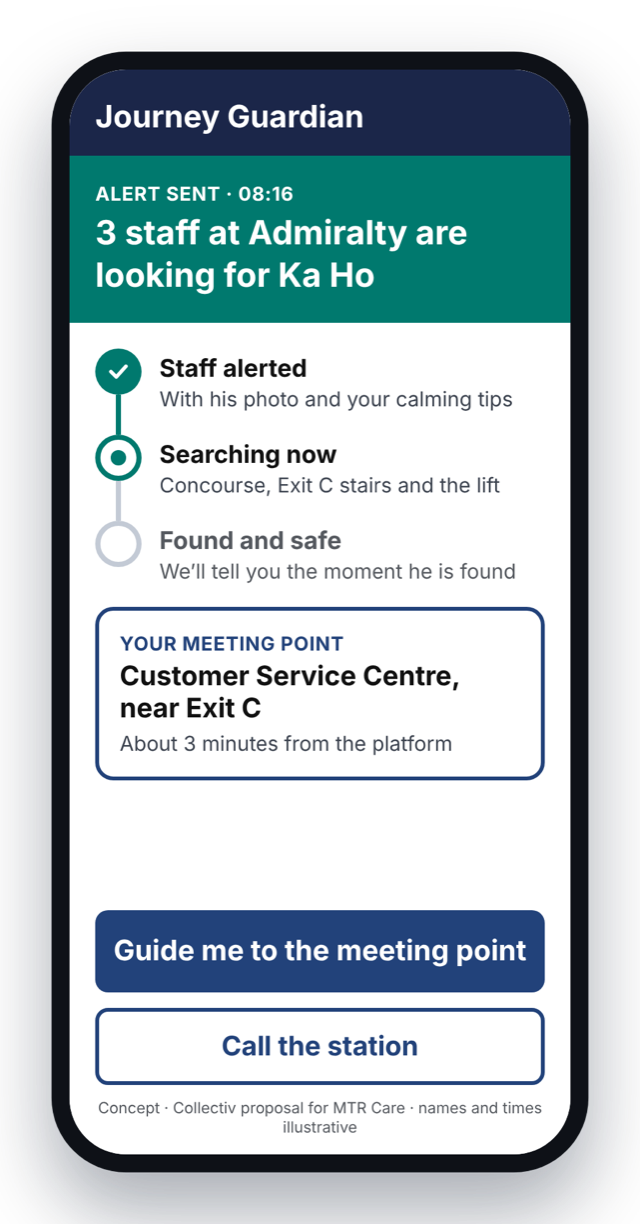
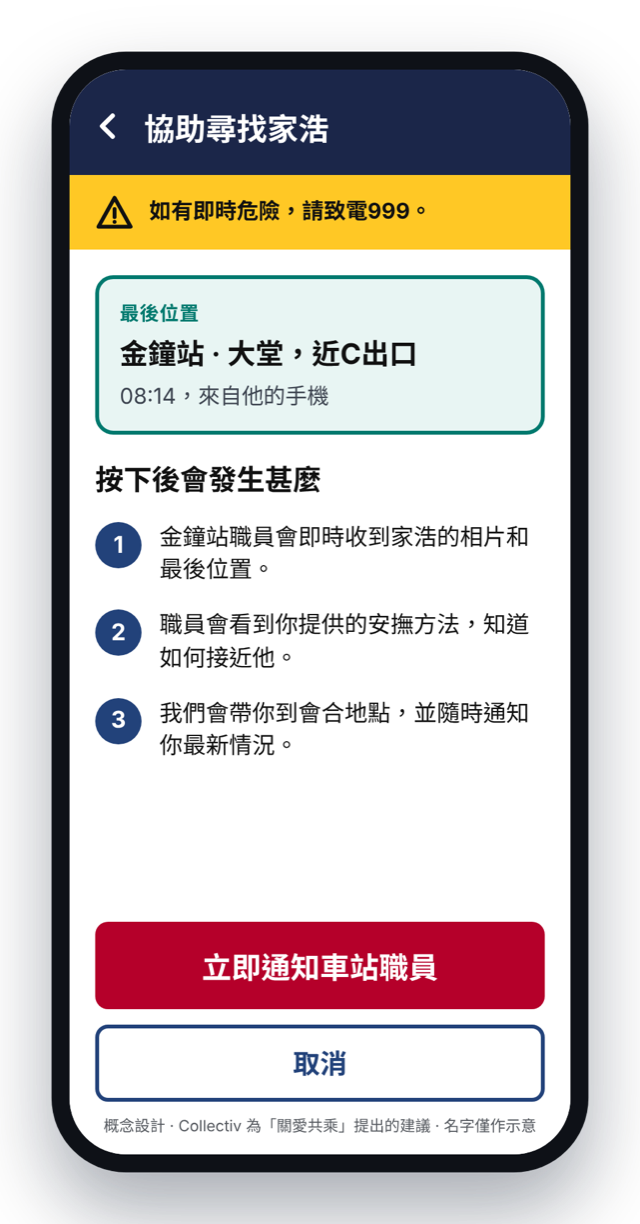
Run the drill on the real Admiralty concourse. One tap from the parent; staff alerted within seconds; a search that starts from the last-known point and splits across the likely routes the model works out.
Why the last-known point matters
Every minute without a location, the search area grows.
Drag the slider: minutes since anyone last knew where the child was. Red is everywhere a child could have walked on the concourse by then, around pillars, gates and walls.
Illustrative model of the L1 concourse only, walking at about 1 m/s. Journey Guardian’s position is accurate to about 10 m, so staff search a small circle instead. Real searches depend on crowds, behaviour and layout.
Timings are simulated from walking distances in the model (staff ~1.6 m/s) and are illustrative. For real emergencies the app also reminds parents to call 999.
How it works
Three layers, so no child slips through.
The hard problem is the device, not the map. Each tier works on its own — together they leave no gap.
Gate alerts
Parents are notified when the child’s registered Octopus card taps in or out, at any station.
Live in-station position
With MTR Care on the child’s phone, parents see where they are inside the station, and their last-known location.
Staff response
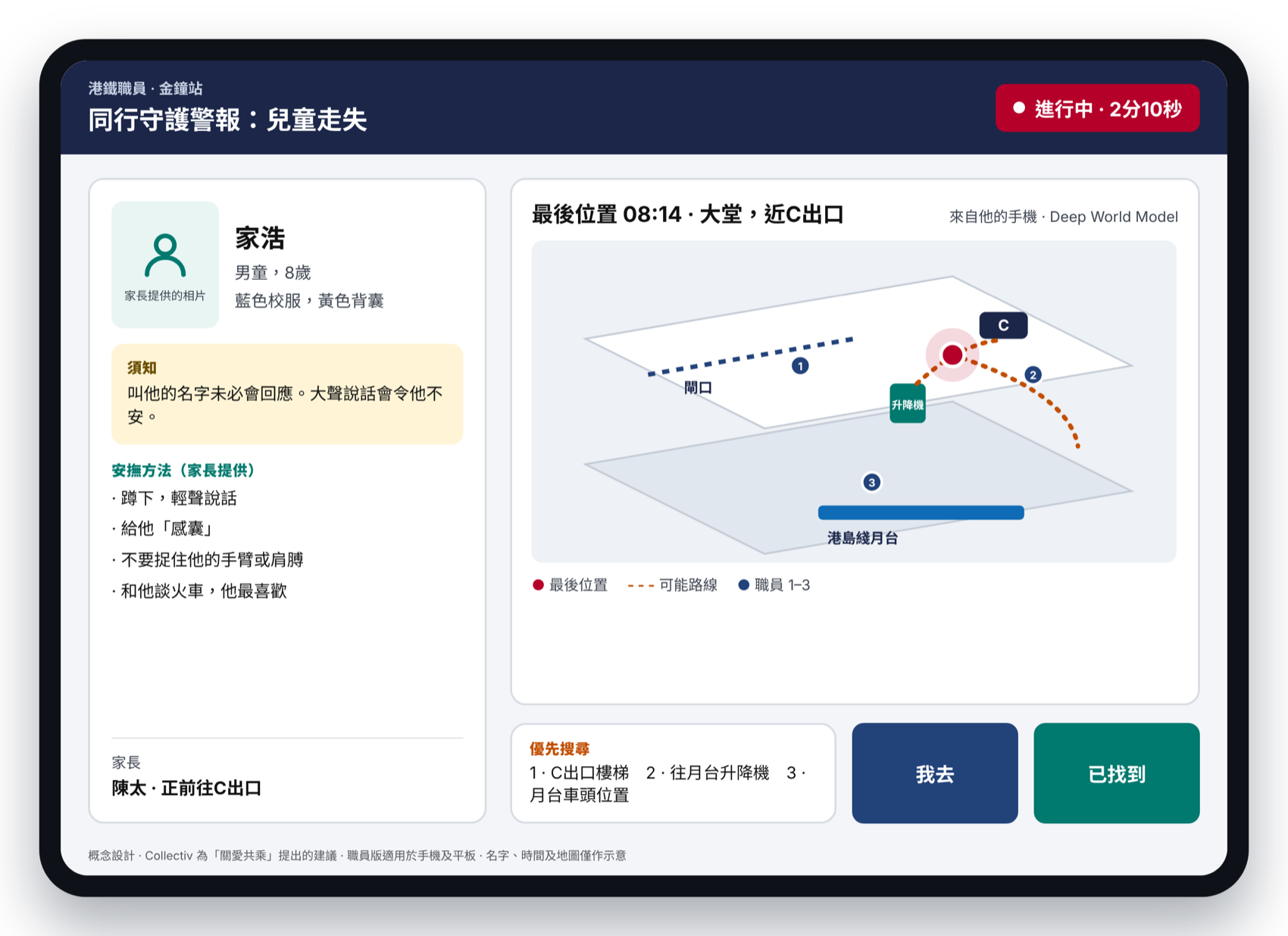
A parent taps “I can’t find my child”. Nearby staff get the last location on a 3D map, a photo and calming tips.
Pick what the child has with them. He falls through any layer that can’t see him, and the first layer that can, catches him.
Tier 3 · The staff tablet
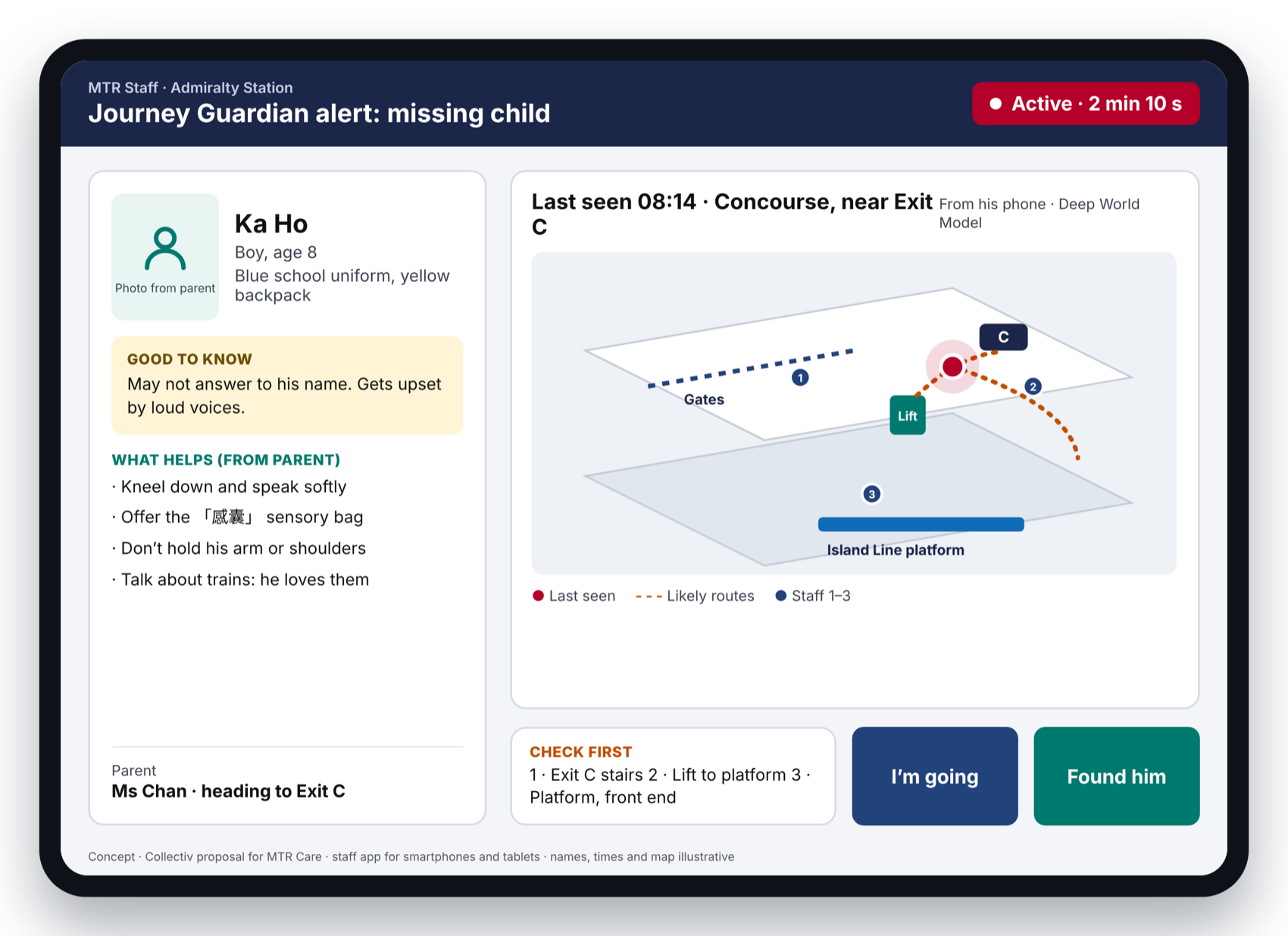
What station staff see, within seconds.
This is the screen that makes it an MTR service. Tap the numbers.
Who to look for
Photo, age and clothes, from the parent. Staff know who they’re looking for without the child having to say anything — critical when 35% of these children can’t give their name.
How to help
What calms him, and what to avoid: kneel and speak softly, offer the sensory bag, don’t grab his arm.
Where to look
The last-seen point on the Deep World Model 3D map — semantic, so it reads “concourse, near Exit C”, not a coordinate.
Who goes where
Likely routes ranked, and every staff position shown, so the team splits up instead of everyone running to the same place.
Runs on the smartphones and tablets staff already carry.
Idea 2 · Only with DWM
Calm Route: a live sensory map of every station.
You arrive on the Admiralty platform by escalator. DWM sees where people are bunching right now and which carriage is quietest. Change the time of day and how sensitive your child is: the route and the carriage are recomputed live on the real platform.
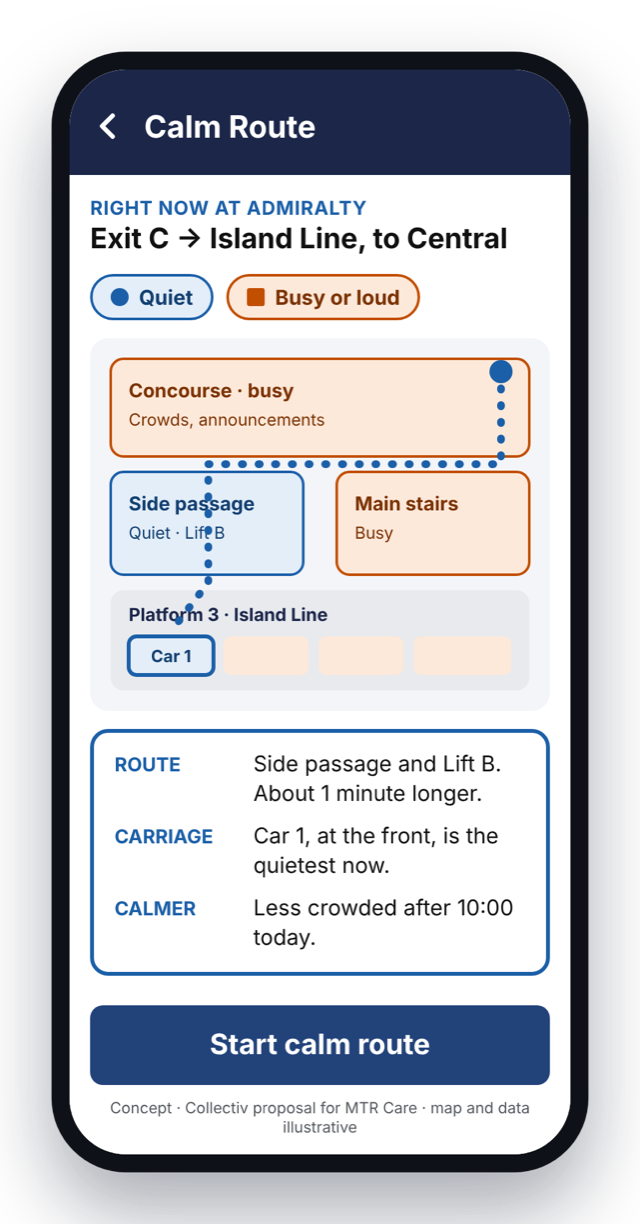
Crowd levels come from the model’s simulation, for illustration. In service, the same calculation would use DWM’s live crowd sensing. Crowding letters follow Fruin’s level of service (C = comfortable, F = crush).
Idea 3 · Builds on Phase 1 · Only with DWM
Daily Check-in, on my real trip.
Phase 1’s Daily Check-in teaches five travel skills in 2D, at any station. Phase 2 puts the same skills on the child’s own route, in the real station, before the first trip, and adds what a generic game can’t: my exit, my escalator, my calmest carriage. Try it.
Any station, drawn in 2D
My own stations, in 3D from the Deep World Model
Gate entry · broadcasts · yellow line · hold the pole · mind the gap
The same five, at the real gate, platform and train, plus my exit and my carriage
Short clips
From soft to real rush hour, at the child’s pace
- Exit C
- Concourse
- Escalator
- Platform · Car 1
Hi! I’m your friend from Calm Corner. Let’s practise Admiralty, Exit C to the Island Line.
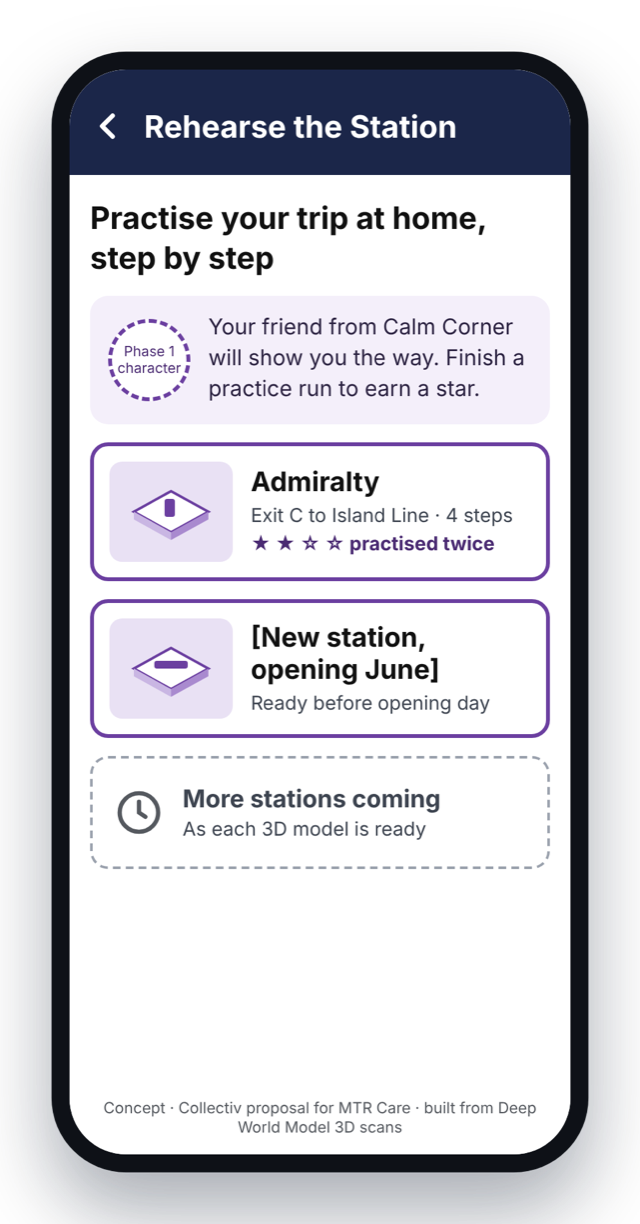
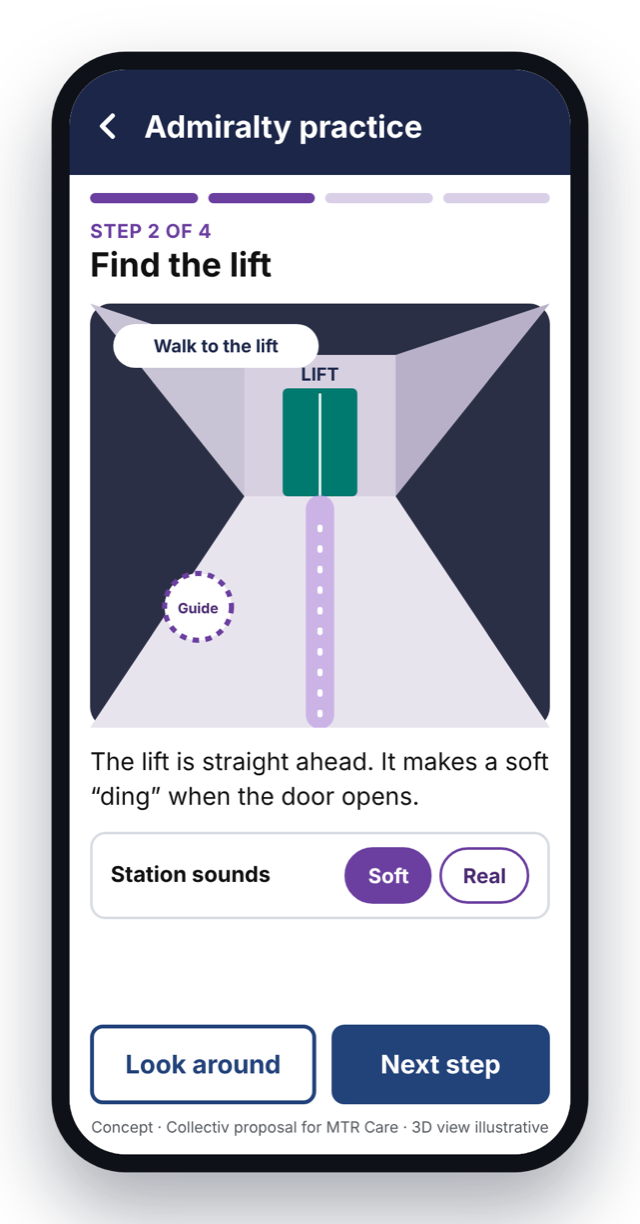
Sources: Simões et al., JMIR Serious Games 2018; Beck et al. 2025. Walkthrough generated from Collectiv’s DWM of Admiralty.
Idea 4
Assist Me: help that comes to you.
A digital Hidden Disabilities Sunflower, built on MTR Care’s existing hearing-impaired assistance. Build Ka Ho’s profile, then ask for help.
What helps Ka Ho
Please avoid
Staff see the profile only when the family asks for help.
New in Phase 2 · A calm moment on the go
“I need a break” works in the station too.
Phase 1’s infinity drawing calms children at home. In Phase 2 it opens with one tap during the trip, while the Deep World Model finds the nearest quiet spot in that station, right now.
A bonus for MTR: demand data
Every request tells MTR where and when sensory bags are needed — so stock goes where families travel. Illustrative pilot view:
Hidden Disabilities Sunflower began at Gatwick in 2016; TfL has offered a Travel Support Card since 2009. Concept screens; demand view illustrative.
Idea 5 · New in Phase 2
My Voice: one tap speaks for the child.
35% of these children can almost never say their name or a phone number. Tap a picture: the phone says it out loud, and nearby staff see it too.
Idea 6 · New in Phase 2
Stop Countdown: always know how many stops to go.
Not knowing when a wait will end is hard for many autistic children. The countdown fills as the train moves, buzzes before the stop, and shows what to do next.
Changes in pictures · when the plan changes
A change on the line? Ka Ho sees it in pictures.
For many autistic children, an unexpected change is the hardest moment of a trip. Today it arrives as a fast spoken announcement. MTR Care turns it into three picture steps on the child’s phone, and tells the parent.
1The station says
2Ka Ho’s phone shows
3Mum is told
✓ Ka Ho has seen the new steps.
Does it work on a phone?
Built for the phone in a parent’s hand.
Everything above runs here too, inside MTR Care, on the same Admiralty Deep World Model. Tap through it below, or scan the code and try it on your own phone.

safelyhome.mnglab.cc/phone.html- Light to download. About 2 MB to open the live 3D, 4.4 MB with the Rehearse storybook, measured on the live site. Lite mode also runs about a third of the simulated passengers, no scan point cloud and no glow effects.
- Touch first. Drag to turn the 3D, pinch to zoom, big buttons a child can press.
- 2D maps and reduced motion in Display settings, for older phones and for children who find motion overwhelming.
- Honest limits. The 3D needs WebGL 2, on phones from roughly the last 4–5 years. Older phones get the 2D maps. Real-device testing is part of the Q1 trial.
Bilingual from day one
中英雙語 · 家長及職員同樣適用
MTR Care already runs in English and Traditional Chinese, so every Phase 2 screen ships in both. Front-line staff will mostly read the Chinese version.
Proven elsewhere
Every piece already works somewhere in the world.
Railways, airports and police forces have run each part of this proposal for years, at scale, including right here in Asia. We found none that combines all of them in one service. MTR can be the operator that puts them together.
Numbers that worked
Every part of Phase 2 already runs somewhere
💳 Gate & journey alerts
📍 In-station guidance
🧑✈️ Staff response & hidden disability
🧸 Rehearse, sensory & fun
MTR Care · Phase 2
Sources: Hanshin press release (Dec 2019); Impress Watch; HK01 (2022); etnet (Sep 2023); Project Lifesaver International and US police/county reports; UK police forces (Herbert Protocol); Hidden Disabilities Sunflower, Air Canada, SBB and Being Patient (Dec 2025); TfL press release (Dec 2015) and ITU; MTA (2023) and TMB; Irish Times / Shannon Airport (2017); Chicago Department of Aviation; TransLink (2020); Eurostar; Metrolinx / TTC / COTA (MagnusCards); Singapore Caring SG Commuters and SMRT; Hidden Disabilities Sunflower directory and International Airport Review (HKIA, 2026); Changi Airport Group (Feb 2022); The Arc / Massport / NBC Boston (Wings for Autism); Pittsburgh International Airport (2019); TfL (Please offer me a seat); Catalan News (Aug 2025); JR East; WMATA / APTA. Figures are as reported by each programme.
Built to perform, built to be trusted
How it works under the hood.
Every hop in the chain already exists. Phase 2 connects them — with clear design targets that the pilot will measure.
Latency budget · parent tap → staff alert
Pilot design targets, to be measured and reported during the pilot.
Graceful degradation · what if something fails?
Isn’t this just a tracking app?
No. Location sharing is parent-authorised and child-visible, and its purpose is a staff-backed safety net inside MTR stations. The differentiator is Tier 3: trained staff with a photo, calming tips and a 3D last-seen point.
What if Octopus integration takes time?
The pilot doesn’t depend on it. Tiers 2 and 3 and Assist Me run on the station positioning network, DWM and staff devices that are already deployed. Gate alerts join in the scale phase once MTR and Octopus agree.
How accurate is in-station positioning?
Typically 2.5–5 m today, and it varies with layout, crowds, the phone and signal conditions. The features are designed around zones (“lift lobby”, “platform, front end”), not exact metres, and DWM snaps each fix to a meaningful place. We will measure and report accuracy at each pilot station.
Will it drain the child’s battery?
Positioning only runs while sharing is on and the child is inside a station; outside stations it falls back to gate events. Battery impact will be one of the pilot’s reported measures.
What do staff need to learn?
It runs on devices staff already carry and extends the existing hearing-impaired assistance workflow. One alert screen, two buttons: “I’m going” and “Found him”.
Beyond SEN
One platform, many passengers.
Build once for SEN; every new audience reuses the same modules. Pick a passenger.
Honest about accuracy
Today our in-station positioning is typically 2.5–5 m, and it varies with station layout, crowd density, the phone and signal conditions. That is already enough for what these features need: which zone, which lift lobby, which end of the platform. DWM snaps each fix to a meaningful place, and accuracy will be measured at every pilot station rather than promised up front.
Accuracy shown is our current typical range and is illustrative of zone sizes. Multilingual examples: Urdu, Nepali, Tagalog and more.
Marketing value
Built to be talked about, and built to win.
MTR Care already wins awards. Phase 2 gives it a bigger story: the first metro service where a child’s whole trip, from gate to platform, is watched over by the station itself. That story travels from Hong Kong family chat groups to the world’s transit stages.
Where it can win next
How the noise builds
Stories the media will want
港鐵推「同行守護」:SEN 童在站內走失,家長即時知位置
Award facts: MTR Corporation awards page and press releases; UITP; IAB Hong Kong / Cherrypicks (2025); HK ICT Awards (2024); Digital Accessibility Recognition Scheme (HKIRC, Digital Policy Office). Award categories change by cycle; “where it can win next” shows fit, not guaranteed results. Headlines are illustrative.
For the awards and the press
Five world firsts MTR Care can claim.
Each one is buildable on what MTR already has, and each one helps a real family. Tap a claim to see the headline, why it holds, and the award it targets.
“World first” is our current belief from public sources, not yet a verified fact. Before any press release, MTR Corporate Communications and an independent reviewer should check each claim against other metros (e.g. sensory guides at Chicago O’Hare and Midway, TfL’s travel-training, Japanese station-staff assistance), and the wording should say “first metro to…” only where that check holds.
In the full deck
There’s more behind every idea.
This is the short pitch. The full deck has every idea in depth, the evidence, delivery, privacy and how we measure success. Tap any card to open it there.
Choose how to start
Three ways to begin. We recommend Option B.
Each option builds on the one before, so MTR can start small and grow without rework. Pick one to see what’s included.
Scope, timings and family numbers are proposals to agree with the MTR Care team. Fees to be agreed: [scope and fee].
Plan
A phased path, with something real in Q1.
Admiralty is already modelled, so we don’t wait for the pilot to show progress: a hands-on trial at Admiralty runs in Q1 2027. Start with what needs no third party. Click a phase.
Dates are proposals to agree with MTR Care.
How it gets delivered and run
One accountable partner, safe operations, privacy by design.
The questions MTR’s IT, operations and legal teams will ask, answered up front.
From Phase 1 to Phase 2, without a gap
Phase 1 (Calm Corner games and Daily Check-in) is delivered by the current vendor. From Phase 2, Collectiv takes over as MTR Care’s primary vendor: one partner accountable for the app, the Deep World Model and the staff tools.
- Phase 1 stays live and untouched while we take over
- Full handover of code, design system, app store accounts, analytics and release pipeline
- Regression tests on every existing MTR Care feature before any Phase 2 release
- One support line and one release plan for MTR
Who answers when a parent taps “I can’t find my child”?
The station team on duty, using the phones and tablets they already carry, supported by the station control room. No new 24/7 centre is needed: alerts only happen while the station is open.
- Alert goes to staff at that station, then nearby stations if no one accepts within a set time
- Escalation: the app always reminds parents to call 999 in an emergency; staff follow existing missing-person procedures
- Closing: “Found him” closes the alert for everyone and the parent is told at once
- Training: a short module plus regular drills, built on the existing hearing-impaired assistance workflow
Keeping false alarms low
Built around Hong Kong’s Personal Data (Privacy) Ordinance
- Parental consent for every child; the child can always see when sharing is on
- Staff see a profile only during an active request, then it disappears from their device
- A Privacy Impact Assessment before the trial, reviewed with MTR legal
- The station model holds spaces, not people: the Deep World Model stores no personal data
Security
- MTR IT security review and an independent penetration test before launch
- Staff tools behind MTR sign-in, on managed devices
- Separation between the passenger app and staff data
- Monitoring, incident response and uptime reporting to MTR
Safety and liability
- Journey Guardian is an aid, not a replacement for supervision; this is clear in the terms and the app
- If any part of the service is down, normal station procedures apply as today
- Games lock automatically at gates, escalators and platform edges
- Terms and consent wording shaped with MTR legal
A small group that meets often
| MTR Care | Station operations | MTR IT & legal | Heep Hong & Caritas | HKUST | Collectiv | |
|---|---|---|---|---|---|---|
| Product decisions | Approves | Consulted | Consulted | Consulted | Delivers | |
| Staff workflow & drills | Consulted | Approves | Advises | Delivers | ||
| Privacy & security | Consulted | Approves | Delivers | |||
| Families & content | Consulted | Co-designs | Delivers | |||
| Outcomes study | Informed | Consulted | Leads | Supports |
Steering group every two weeks during the trial and pilot; a single Collectiv delivery lead as MTR’s point of contact.
How we prove it
Measured honestly, with partners who know families.
Some things a system can time to the millisecond. Others depend on people, crowds and a child’s day — those need careful study, not a headline number. So the pilot separates them, and every result is reviewed independently before anyone quotes it.
No results are shown here on purpose: the pilot will produce them.
The questions your teams will ask
Ready to run inside MTR.
Operations, IT, legal and your management will each ask how this works on a real day. Here are the answers, one tap each.
Targets, dates and retention periods are proposals to agree with MTR Care, Station Operations, IT and Legal. Coverage colours are illustrative until the Admiralty survey is done.
The ask
Four decisions get families travelling at Admiralty in Q1.
Every journey,
safely home.
MTRMTR · Care×MTR Care × Collectiv · Concept proposal · Names, timings and data in demos are illustrative.